 International Institute of
 Cosmetic Surgery &
Aesthetic Medicine
International Institute of 
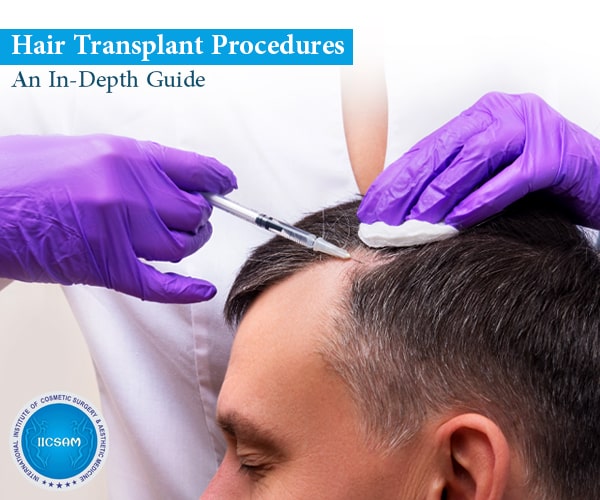
Hair loss is a prevalent condition that is seen in a lot of people of today’s time, and the only permanent remedy to the situation is a hair transplant. The hair transplant procedures are non-invasive and bring in a natural look to the receding hairline. With the ever-increasing need for hair transplant surgery, the requirements for trained surgeons are going up by the day as well. Several reputable institutes like IICSAM train medical professionals to be experts in the field. To opt for such a course, it is vital to know what hair transplant surgery is all about.
In general terms, hair transplant is a process where follicles from one part of the body are removed and implanted to the area that needs treatment. The area from where the follicles are removed is called the “donor site” and the area to be treated is called the “recipient site.”
1. FUT: Follicular Unit Transplantation is a technique where a strip of the hair that contains follicles is taken from the scalp. Following this, the follicles are segregated from the strip and then grafted to the recipient site. FUT might be an older method that leaves a scar on the back of the head, but it is a very effective way as well. Trained surgeons work with thousands of grafts in one single session, ensuring the best and most natural-looking results out of the procedure.
2. FUE: Follicular Unit Extraction is a method where follicles are directly extracted from the scalp. The reason why FUE is preferred among both the hair transplant procedures is that the process has a faster patient recovery rate. Doctors who are certified from the American Board of Hair Restoration Surgery are best suited for the job as only they will be able to make sure that the follicles are extracted accurately.
Several steps have to be taken into consideration when performing hair transplant procedures. If summarized, they fall under two broad sections of preparation.
1. Donor Area: The first step in the process is to prepare the donor area for the surgery. In this, the hair on the donor area is trimmed and is put under local anaesthesia. Then, according to the process, the tissue in the donor area with bald resistant hair follicles are extracted.
2. Recipient Area: Once the donor site is prepared and the follicles removed, the balding area is set-up for the treatment. There is no need to shave or trim the recipient area. Then, the grafts are placed on the scalp according to the procedure performed.
There are numerous factors which contribute to giving the most beneficial results out of hair transplant procedures. This includes the final cost of the surgery that depends on the number of grafts that have been performed. The more the number of grafts, the higher the rate. The success or failure of a hair transplant surgery depends on the quality of the donor hair as well. A trained aesthetician will be able to fully ascertain what procedure to choose and which would act as the best donor site.
At IICSAM, you get ABHRS certified doctors who provide hands-on hair transplant training for professionals that touches all aspects of hair transplant procedures.
Conclusion: As a medical professional, if you want to take up a speciality in hair transplant as your career, you might want to opt for the hands-on FIT and FUE training courses provided by the International Institute of Cosmetic Surgery and Aesthetic Medicine. This 2-days per month course is presided over by Dr Satya Saraswat and Dr Preeti Saraswat, ensuring you get to know all about hair transplant procedures through lectures and demonstrations. To know more, call us at +91-9149112892.
Date: Contact Us to Know
 Becoming a Laser Hair Removal Expert: Insider Tips from Industry Leaders
 Discover How Cosmetology Courses Enhance Medical Practice for Doctors?
 Elevate Your Practice: Specialized Cosmetology Training for Doctors
 Transform Your Career: Laser Hair Removal Training for ProfessionalsUnleash Your Potential: Become a Laser Hair Removal Specialist Today!